
The Devastating Economic Effects of Statehood for Puerto Rico
The imposition of federal income taxes under statehood is a significant obstacle for those who wish to see Puerto Rico become a U.S. State. Under the current status, Puerto Ricans do not pay federal income taxes to the U.S. government. However, if Puerto Rico were to become a state, its residents would have to start paying income taxes to the U.S. government, just like residents of the other fifty states. This would bring great difficulties and the possible financial ruin of many Puerto Rican merchants and professionals, who would face a significant increase in their tax obligations. Keep in mind that the local government of Puerto Rico currently needs a relatively high income tax rate to fund its services.
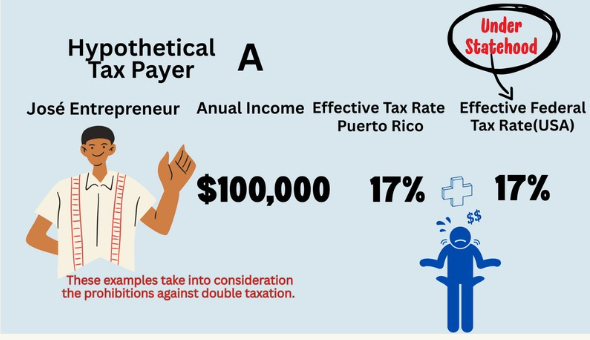
Let's examine two scenarios that two Puerto Rican taxpayers might encounter in order to get a clearer idea of how bad the economic crisis would be if federal taxes were applied under statehood. One is a real-life Puerto Rican, and the other is a fictional or hypothetical Puerto Rican. We will use José Entrepreneur as the example of the fictitious Puerto Rican. Assume José is a small business owner who earns $100,000 a year. As a hypothetical character, José represents entrepreneurs who have the eventual potential to create new jobs. With an annual income of $100,000, José pays an effective tax rate of 17% in Puerto Rico. Since Puerto Rico is not a state, José doesn’t have to pay any additional income taxes to anyone else. However, if Puerto Rico were to become a state, José would have to pay additional U.S. income taxes and file an additional tax return. On this second tax return, José would be required to make a second payment at an effective rate that would likely also be around 17%. As you can see, under statehood José Entrepreneur would pay much more in taxes. He would have to make one payment to the government of Puerto Rico and another to the U.S. federal government. Even after deducting local taxes from the federal tax return, José would be paying approximately 83% more in taxes under statehood.
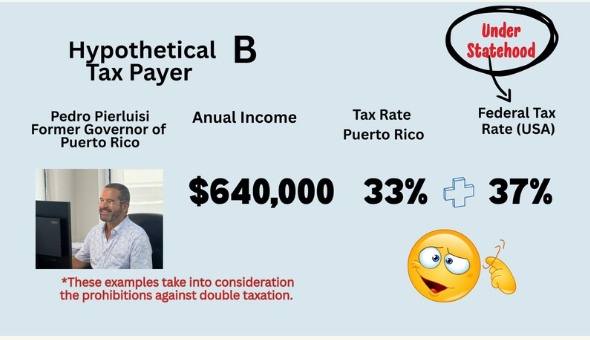
Our second example is a real-life one. Let’s talk about Former Governor of Puerto Rico Pedro Pierluisi, who, as you probably already know, is a proponent of statehood. In 2018, Pierluisi had an income of $640,000. With these earnings, he had to pay taxes to the local government of Puerto Rico at a rate of 33%. However, if Puerto Rico had been a state, in addition to paying 33% to Puerto Rico, Pierluisi would also have been required to pay taxes to the U.S. federal government at an additional 37% tax rate. As you can see, under statehood, Pierluisi and the upper class in Puerto Rico would have to pay astronomical sums of money in taxes. This tax increase would be so steep that it would be very difficult for these wealthy Puerto Ricans to continue with their investments and businesses in the archipelago.
Statehood is not viable due to the additional tax costs it entails. Its imposition on Puerto Rico would create a perfect storm that would impoverish Puerto Ricans and prevent José Entrpreneur—or, rather, people in roughly the same position as José—from climbing the economic ladder as we all would like. As you can see, statehood would condemn Puerto Ricans to perpetual poverty, diminishing local capital, and accelerating even more gentrification on the Island. Despite the great economic disaster that statehood would cause, proponents of this formula insist that their proposal would improve the economy, because, supposedly, Puerto Rico would receive more federal funds from the United States if it were a state. However, the new funds that Puerto Rico could potentially receive would come primarily from two social welfare programs: SSI and Medicaid. These two programs exist exclusively to help people who are indigent and are unable to work due to their age or medical conditions. Although these programs provide important assistance to people in need, they are not capable of promoting the economic development and the local capital that Puerto Rico desperately needs to emerge from its current crisis.
Do you like this page?


